“I Can’t Breathe”
Finding the courage to speak with our high school students about truly difficult subjects
By David Barham
“Give me your tired, your poor, Your huddled masses yearning to breathe free…
— Emma Lazarus, The New Colossus/November 2, 1883
Breathing and Adolescence
As the young person approaches adolescence—moving toward what Rudolf Steiner calls “earth maturity”—we begin to see profound physiological shifts. The lungs expand in capacity, circulation reorganizes, the limbs lengthen, and the skeleton comes into a new stability. These are not merely outer changes; they are expressions of a deeper reordering of the human being, a “Grand Metamorphosis,” and the beginning of an intense process of individuation.
In Waldorf education, the transformation of breathing at puberty can be understood as the physical announcement for a new capacity: the emergence of independent judgment. Similar to what the change of teeth signifies around the age of seven, we become aware that new possibilities are being born in the young person. What was once a more permeable, imitative relationship to the world begins to give way to a new experience of inwardness. A necessary distance arises between the young person and their surroundings.
Prior to puberty, the child lives in a kind of unity with the world. Experience flows directly into response. As adolescents grow, their lung capacity increases, allowing for deeper breaths. The unity of the child and the world loosens. The young person is, in a sense, “set back” from the world. “Earth maturity” begins to dawn, as the adolescent is inwardly propelled into a more distinct experience of self in relation to the outer world.
This deepened breathing introduces a pause where previously there was immediacy. Feeling no longer moves directly into action; it is held, reflected, and in that moment of inwardness, something new becomes possible. The adolescent can begin to look back on experience, to weigh it, and gradually to form their own conclusions rather than simply living within the given.
The curriculum of the grade school years, roughly ages seven to fourteen, consciously cultivates the rhythmic system—the interplay of heart and lungs—through image, story, imagination, and teaching to the feeling life. As the breath and pulse come into a new relationship at puberty, the formative forces that once shaped the body are, in a sense, released. They become available for thinking. What was once growth becomes insight; what was once imitation becomes judgment.
This marks a subtle but decisive shift: the life of soul and spirit begins to take hold of the bodily instrument in a new way. The individual “I” starts to find its bearings, no longer only shaped by the world, but beginning to shape a path within it. Like Parzival after his first failure in the Castle of World Salvation (Munsalvaesche), the adolescent is working toward taking control of the reins of their destiny and beginning to consciously guide their own life journey.
Pedagogically, this calls for a corresponding movement on the part of the teacher. The teacher steps more to the periphery, allowing the subject matter itself to come to the center. The task becomes one of guiding inquiry, of accompanying students as they learn to meet content with their own thinking. What begins in ninth grade as a still-subjective encounter with the world can, by twelfth grade, mature into a more grounded and conscious objectivity. Rudolf Steiner speaks about this period of education as an “awakening education,” writing, “The students should now feel they are calling on their own individuality, and all education, all teaching, will be perceived as a stimulus and awakener.” (Waldorf Education and Anthroposophy II GA 304a August 30, 1924, London). This continuous waking up is necessary for inner intellectual and moral independence.
“I Can’t Breathe”
As Waldorf educators, particularly those working with our oldest students, we are continuously striving to help them develop the capacity to form independent judgments. We work hard to ensure our students are free from the tyranny of our particular bias and that our political judgments do not impede the process of our students learning to weigh and sift the facts before arriving at their own conclusions. We worry about “being political” in the classroom.
And yet, our high school students do need support in understanding the world, the good, the true, and the beautiful, as well as the many times when society falls short of these ideals. How do we help create brave spaces in our classrooms where our adolescent students can reckon with the most difficult of events without growing cynical, shut down, or too frightened or confused to act?
How can a soul life be nurtured that is able to breathe freely between self & world, bodily experience & spiritual ideals?
And what about when the world is scary and dark?
The phrase, “I can’t breathe,” became a slogan of the Black Lives Matter movement in the United States. These were the last words of Eric Garner, who was killed in 2014 after being put in a chokehold by a NYC police officer. A number of other Black Americans, including Javier Ambler (2019), Manuel Ellis (2020), Elijah McClain (2019), and George Floyd (2020) have said this same phrase during similar encounters with law enforcement. The New York Times reported in 2020 that the phrase was uttered by over 70 people who died in police custody. The phrase is now used in protests against police brutality and racial inequality in the US.
While the Federal government can declare “woke” to be dead, true educators must continue to strive to help our adolescent students make sense of the world. How to support moving through the horror to understanding, compassion, and resolve?
As a teacher of high school history, civics, government, and the US Constitution & Bill of Rights, I felt giving students real tools was at the heart of what was needed. Helping students contextualize and make sense of what might otherwise seem like random and overwhelming violence and chaos allows for classroom discussions that can bring meaning.
Steps to Creating a Brave Space in the Classroom
• Clarifying ground rules for classroom discussions and debates that allow for freedom of opinions as long as they are not intentionally hateful or consistently singling out a particular person/group. Ideas include: “Controversy with civility” where varying opinions are accepted; “Owning intentions and impacts,” in which students acknowledge and discuss instances where a dialogue has affected the emotional well-being of another person; ‘Challenge by choice,” where students have an option to step in and out of challenging conversations. All are encouraged to find their growth edge and expand; “Respect,” where students show respect for one another’s basic personhood; and, “No attacks,” where students agree not to intentionally inflict harm on one another. Critique the idea, not the person.
• Bringing context: Students need help understanding the larger historical, societal, and cultural background for specific issues. In the example in this essay, students need to understand the history of policing in the US, racism, and historical trends that have led to higher rates of fatal encounters between Blacks and police as compared to other racial groups.
I truly believe that if more people knew what was in their foundational documents- if more Americans knew what was in the preamble to the Declaration of Independence, the Constitution, and the Bill of Rights, they would far better understand the various crises we are living through right now.
• Teach that the American story has never been a single story. While people in one region of early America wanted democracy and believed all humans were created equal, others believed in a hierarchy based on class, race and gender, where, with apologies to George Orwell, all Americans are equal, but some are more equal than others. It is important for students to know this country has had multiple stories run through it from the start, that these opposing visions or origin myths have threatened to tear this nation or federation apart.
There is the image of All Men/All Humans are created equal from July 4, 1776. And there is the story expressed by Alexander Stephens, Vice President of the Confederacy in his March 21, 1861, so-called “Cornerstone Speech.”
Our new government is founded upon exactly the opposite idea; its foundations are laid, its corner-stone rests, upon the great truth that the negro is not equal to the white man; that slavery subordination to the superior race is his natural and normal condition. This, our new government, is the first, in the history of the world, based upon this great physical, philosophical, and moral truth.
• Media literacy. I recently taught an online Civics course with a mixed age group of 8/9/10th graders and asked the students where they got their news. I was expecting them to say social media, TikTok, etc. Some did. But a full 80% of the large class told me they got the majority of their news from their parents. Nothing wrong with discussing current events with one’s parents, but I believe that on this road from subjectivity to objectivity, toward forming independent judgment, students need to learn to read the news- to understand bias, both the media’s and their own; to understand local, state, national and international news, and be aware that different news sources filter the news through different lenses and that multiple sources are needed to weigh, sift, and compost for oneself; and, that there is a difference between a news article and an editorial or opinion piece.
With this new world of AI, learning the skill of discernment is harder than ever. We may have had to parse a politician’s words to determine if they were telling the truth or lying, but now, our students need to figure out if the words coming out of the realistic-looking mouth of that person is real or entirely made up. What was once hard is now really hard.
• Steiner tells us that when children come to the age of puberty, it is necessary to awaken within them an extraordinarily great interest in the world outside of themselves, to awaken the most intensive interest in world-riddles. How do we square that with growing up in a world that even many adults feel the need to turn away from to stay sane?
Holocaust survivor Viktor Frankl says the ultimate drive in the human soul is to find meaning. The Existential Vacuum: When the will to meaning (described by Frankl as the predominant urge in the human soul) is frustrated, it can lead to a state of boredom and distress. Frankl speaks of depression, aggression and addiction being natural in the face of this existential vacuum or lack of meaning. Frankl also speaks about how in the presence of this inner vacuum, inner emptiness, lack of meaning, people (and this is especially true of adolescents) wish to do what other people do (conformism) or do what other people tell them to do (totalitarianism).
• Education with adolescents must breathe deeply between blissful heights of creativity and beauty AND an earthly world of police brutality, prisons, war, and violence. Our students must recognize in us that, through anthroposophy, we are committed to peace, economic justice, and the health of the environment. John Schuchardt, co-founder of The House of Peace in Ipswich, Massachusetts in 1990, says, “Truth is the only force more powerful than lies, and that the challenge of our times is to know evil, be a witness for truth, and to unmask and name the spiritual forces of our age.” He goes on to write, “If anthroposophy is not recognized as a committed peace, economic justice, and environmental movement, why would it be of any interest to the rising generation?” (including our own adolescent students).
(from Moved by Destiny: Life Stories of Social Engagement, edited by Christopher Schaefer, PhD, © 2026)
We must strive to help our adolescent students find meaning in the world. We must help them learn to breathe in the beauty of the world and to find ways to embrace those who cannot breathe.
Say Their Names:
Eric Garner
Javier Ambler
Manuel Ellis
Elijah McClain
George Floyd
“ I can’t breathe” were the last words of these American Black Men before dying during law enforcement encounters. According to the New York Times, the phrase has been used by over 70 people who died in police custody in the United States.
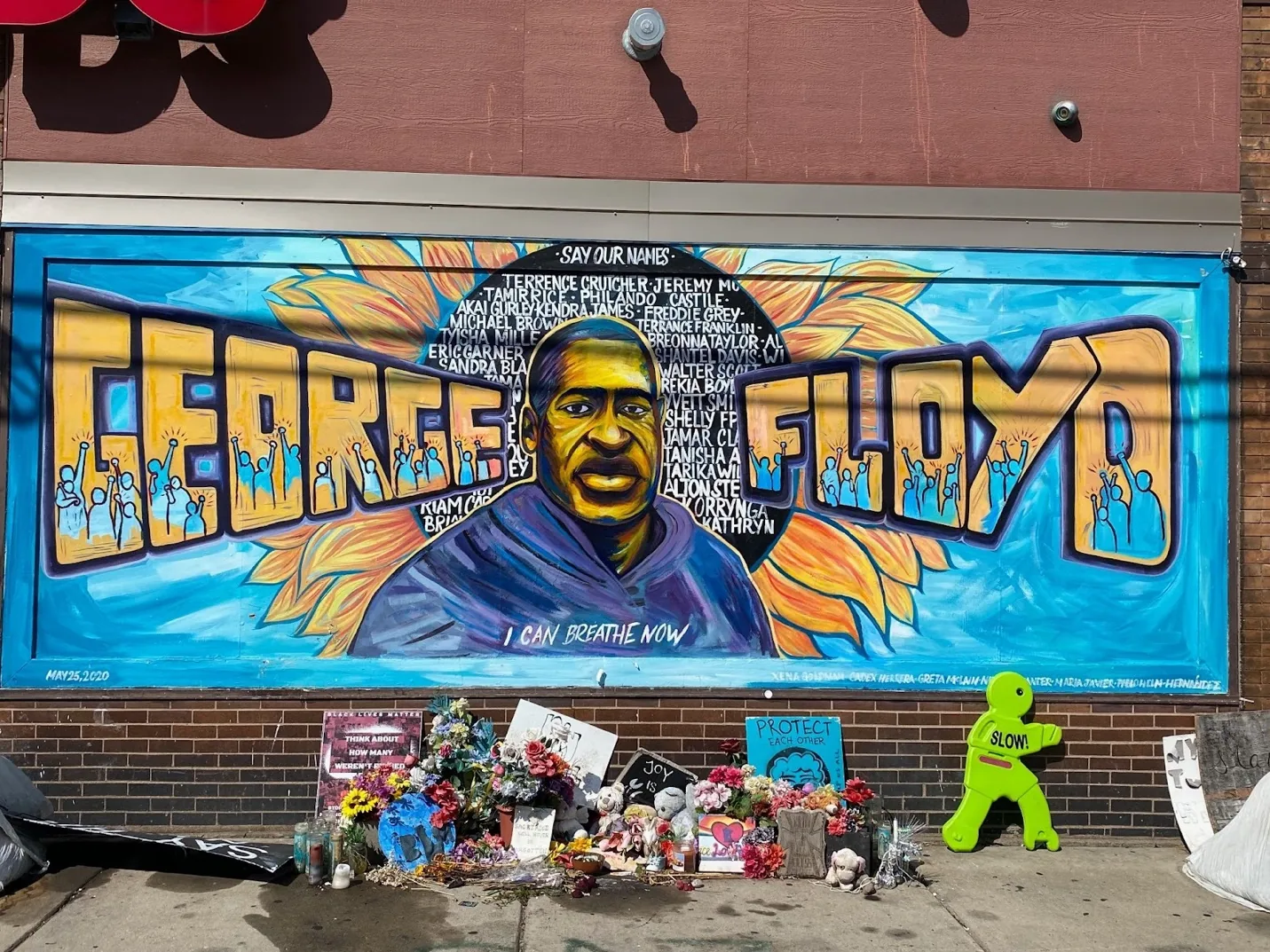
Photo taken by the author at the George Floyd Memorial Site in Minneapolis, Minnesota